Don Marenzi,
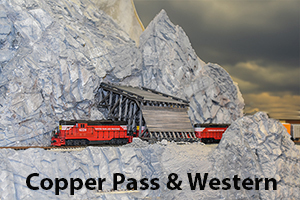
Copper Pass and Western, HO.
Concept:
A freelanced-prototype railroad in Alaska. Based on a route that was proposed and surveyed, but never built.
The route runs north from port facilities on the Pacific Ocean to the Yukon River and serves various resource areas.
The principle traffic consists of copper, zinc, coal, forest products and other minerals southbound; supplies, fuel and manufactured goods northbound.
Interchange with the rest of the North American rail system is by trainship and ocean going railcar barges.
Off layout physical connections include the Alaska Railroad (actual), and a CP Rail owned branch in the Yukon (mythical). This allows ARR and CP power to appear on run through trains on the CP&W.
The modeled section of the line represents the south end of the railroad, featuring a helper district as the route crosses the costal mountains into a resource rich wilderness area.
The era is set during 1976, during the construction of the Trans-Alaska Pipeline. Motive power is mostly 1st and 2nd generation EMDs with some early ALCo power.
The Layout:
The layout is built in a 19 x 22 foot garage. HO scale, point to point, with a ten track stub end staging yard at each end.
Walk around style, full double deck, around the walls, with a center peninsula.
The 300 foot mainline has five towns, plus one additional passing siding between the two end staging yards. A branchline serves three additional towns.
Two additional smaller staging areas represent other branch lines. A helix connects the two levels. There is a nod-under and one step to enter the layout.
Control is by CVP EasyDCC wireless throttles.
There are a few sound equipped locomotives on the layout.
Current Status:
All mainline, passing sidings, staging, and most industrial trackage is complete.
Ballasting and basic scenery is about 50% complete. Mountains and structures are progressing, although far from complete.
Operations:
Traffic control is by Timetable and Train Order.
A 3:1 clock is used resulting in a four hour session representing a twelve hour half day.
Each session has 5 scheduled trains plus another 8-10 trains that run as extras.
Train orders are issued by a dispatcher located outside the layout room to a single "system" train order operator located inside the peninsula of the layout.
An order board system and facia panels indicate to crews when trains need to pick up orders.
A phone system (by MRCS) is used for communications.
Prototype based paperwork and procedures are used including train orders, clearances, rulebook and an employee timetable.
The focus is on the challenge of moving trains over the line using "classic" full rules TT&TO on a single track mountain railroad.
The goal of a session is to do this at a high level of prototypical adherence, striving for the crew
to have the feeling of having 'worked' on the railroad. Understanding the concepts and rules of TT&TO along with the appropriate paperwork involved is an important part of this experience.
Car routing is by car card/waybills.
The waybills have a destination code (similar to real RR's Clic or Spins codes), along with hazmat placards, to aid train blocking; simplifing the correct movement, pulling, spotting and blocking of cars, especially for new operators. Traffic follows what would be appropriate to the area and industries modeled. Each train that runs has specific instructions and duties. Every station has facia mounted track diagrams.
Revised 11/25/2024